SolInnovate builds AI-powered products for education, research, and enterprises. From AI research enablement to verified knowledge systems to specialized bots, every product is grounded in source discipline, traceability, and zero fabrication.

“I'm advertising this to the college of engineering, along with the testimonials. You may get more requests than you can handle.”Vincent Meunier, Department Head, Engineering Science and Mechanics, Penn State
Two core products for universities and enterprises, with specialized AI solutions in development.

A structured AI enablement program that embeds AI into your team's workflows, producing measurable gains in output, rigor, and efficiency. For university faculty, research teams, and enterprise professionals.
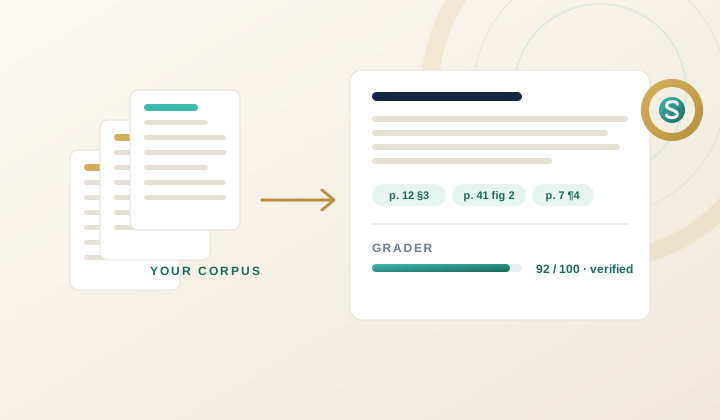
A local-first AI research system that stays inside your lab. Grounded strictly in your own corpus, it gives page-level citations and runs an independent grader, so nothing is cited that was not read. Private by default and installed on your machine in about thirty minutes. For research labs, R&D teams, law firms, and any knowledge-intensive operation.
Not a workshop on AI tools. A structured, multi-session engagement that builds a complete AI-augmented workflow tailored to your discipline, your methods, and your team's specific objectives. Delivered to university faculty, research teams, and enterprise professionals, with cohorts completed at Penn State, Emory School of Medicine, Colorado State, and the University of Connecticut.
Every session built around your active research. Your papers, your datasets, your methodological challenges. No generic demos.
A structured system for documenting how AI contributes to your research. Maintains transparency, supports reproducibility, and addresses emerging compliance requirements.
Literature review, gap analysis, methodology refinement, data interpretation, manuscript drafting, and peer review preparation across the entire research lifecycle.
Case studies drawn from your own field, demonstrating real applications rather than hypothetical scenarios.
You leave each session with working outputs: annotated literature maps, refined research questions, drafted sections, and configured AI workflows.
Built with an understanding of academic integrity policies, IRB considerations, journal disclosure requirements, and AI governance in research.
I'm advertising this to the college of engineering, along with the testimonials. You may get more requests than you can handle.
Even though I have been using LLMs for a while to ease many research-related tasks, I found the AI Research Enablement Program extremely useful. The six-hour investment was well worth it. It significantly increased the efficacy of my LLM use, likely saving me several months of effort to gain the same level of expertise. It was well worth the cost and time.
I was quite impressed at how Faiz learned enough about our research to provide us with customized packets to prepare papers, proposals, and literature reviews. We got to see a variety of AI environments and walked away with concrete tools that we can modify and use. Prior to the workshop, I had played with GPTs in a purely interactive and informal way. Now I understand that prompts can be quite complex, structured, and program-like. That was enlightening.
Faiz demonstrated the assistant power of AI in academic research and provided a powerful philosophical brief of the entire research enterprise. As a first-time user, I approached the training with skepticism. I have come to appreciate the power of the prompts and the proper communication to obtain best results. Faiz provided us with frameworks that ramp up our introduction.
The training sessions were quite useful, even for those of us who are familiar with many of the tools and strategies that were introduced. The sessions were well organized and hands-on; many practical tips were shared and discussed. I also enjoyed learning from the other participating colleagues. I see a great benefit in peer-to-peer communication and exchange. It was worth the time I spent participating.
The sessions were very helpful, accommodating participants with different levels of familiarity with AI. Handouts can serve as a long-lasting tutorial. Faiz even customized them to reflect our individual research interests.
Faiz was well-prepared and went above and beyond in trying to accommodate everyone's hectic calendar. He covered numerous AI tools and use-scenarios, as well as ethics. It was beneficial to hear the various perspectives on AI discussed during the lessons.
The most valuable takeaway for me was the prompt-structuring template that was shared. I had not used a formal prompt structure before, but I now see how important it is. I think this template would be helpful to share with others who want to use AI more effectively.
Most AI tools are confident guessers over the public internet. Verified Research OS (VROS) is a verifiable expert on your organization that you can actually cite from.
Every answer traces to a specific source passage in your documents. If the answer is not in your material, it says so. No invented facts, no fabricated references.
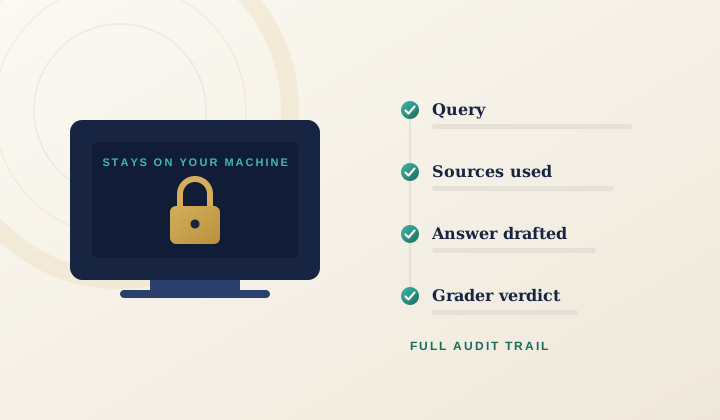
Runs in your own or controlled environment. Your documents, unpublished work, and proprietary knowledge never leave your infrastructure. Built for confidentiality-critical industries.
A log of what was asked, what sources were used, and what was verified. The governance spine that compliance, legal, and leadership require before trusting AI in production.
Our products serve organizations where confidentiality, source discipline, and compliance-grade traceability are requirements, not features.
Universities and Research Centers. Faculty AI enablement, research knowledge systems, and institutional AI governance across departments.
Telecom and Technology. Enterprise AI enablement programs and verified knowledge systems for large technical teams.
R&D, Biotech, and Pharma. Proprietary IP, literature corpora, and research data where hallucination is unacceptable.
Professional Services. Law firms, consulting practices, and accounting firms where knowledge is the product and confidentiality is absolute.
Healthcare and Clinical Informatics. HIPAA-governed environments where provenance, privacy, and traceability are regulatory requirements.
Government, Policy, and Financial Services. Compliance-heavy environments where source discipline, audit trails, and data privacy are foundational.
Most AI vendors talk about trustworthiness as a feature. We treat it as an engineering discipline, because we have studied exactly where AI systems fail and built systems designed around those failure points.
We deliver working, production-grade knowledge systems scoped to your team, your data, and your compliance requirements. Not a proof of concept that gathers dust.
Every answer cites its source. Every query is logged. Every output is auditable. The governance layer is not an add-on. It is the foundation the system is built on.
Our work is informed by 20+ published research papers on AI trustworthiness, covering the specific failure modes that matter for enterprise deployment: fabrication, compliance gaps, and privacy tradeoffs.

Founder and CEO
PhD in Engineering Science and Mechanics from Penn State. 20+ published papers in trustworthy AI, machine unlearning, federated learning, and computational electromagnetics. Designs and delivers all AI systems and the research enablement program. AI Governance and Compliance Advisor.
Delivered at Penn State, Emory School of Medicine, Colorado State, and the University of Connecticut.
A structured four-session program delivered to a faculty or research cohort, working on participants' own papers, proposals, and literature rather than generic exercises. The goal is measurable gains in output and rigor, with verification built into the workflow so it lasts after the sessions end.
Universities and research centers, R&D and biotech teams, professional services firms, healthcare and clinical informatics groups, and compliance-heavy organizations: anywhere confidentiality, source discipline, and traceability are requirements rather than features.
VROS is grounded strictly in your own corpus. Every answer traces to a page-level citation in your documents, and an independent grader scores the answer before you see it. If the answer is not in your material, it says so instead of inventing one.
No. VROS runs in your own or a controlled environment, and it is private by default. Your documents, unpublished work, and proprietary knowledge stay on your infrastructure, with a full audit trail of what was asked, which sources were used, and what was verified.
Most do. Summaries, slide decks, and notes produced with AI flow back into shared folders, so several documents that look independent can trace to a single original source, and a folder can appear to hold more evidence than it really does. VROS answers only from your corpus and cites the specific passages each answer rests on, so you can see whether the support comes from primary sources or from derived summaries instead of trusting a count of documents. When a claim is not actually in your material, it says so. During a build we also work with you to separate primary sources from derived material, so the provenance of an answer stays visible.
VROS starts as a bounded build over one team's knowledge and installs on your machine in about thirty minutes, then expands from there. Program cohorts are scheduled around your department's calendar, typically starting with a pilot group.
Engagements are scoped to the institution: cohort-based for the enablement program and build-based for VROS. After a short discovery call we send a written proposal with exact figures for the scope you choose.
Whether you are exploring a verified AI system for your organization or AI enablement for your team, we would welcome the chance to discuss what an engagement could look like.
Or reach us directly
faizahmad@solinnovate.io